

 4 min
4 minOn May 12, 2026, the German pharmaceutical giant Boehringer Ingelheim (BI) announced a global exclusive licensing agreement with clinical-stage biotech Immunitas Therapeutics, with a total deal value reaching €407.5 million (approx. $478 million).
The centerpiece of this transaction is a preclinical antibody candidate targeting chronic inflammation and autoimmune diseases (AID). While the specific target remains undisclosed in official press releases due to commercial sensitivity, industry consensus—based on Immunitas’ R&D pedigree and recent academic output—points directly toward CD161 (KLRB1), a high-potential immunomodulatory target.
Core Logic: A Paradigm Shift from "Cytokine Blockade" to "Pathogenic Cell Depletion"
For the past two decades, R&D in the autoimmune space has been centered on intercepting downstream cytokines (e.g., TNF-$\alpha$, IL-17, IL-23). However, faced with growing drug resistance and the clinical demand for "deep remission," R&D strategies are evolving from traditional Immune Suppression toward Immune Resetting.
The strategy proposed by Immunitas goes beyond merely blocking signals; it aims for the selective depletion of pathogenic T cells. The underlying biological rationale includes:
-
CD161 Target Specificity: CD161 (encoded by the KLRB1 gene) is highly expressed on the surface of various pro-inflammatory immune cells, particularly Th17 cells and a subset of IL-17-producing CD8+T cells (Tc17). These cells are key drivers of multiple autoimmune conditions, including Crohn’s disease (CD), psoriasis, and rheumatoid arthritis.
-
Precision Strikes via Fc Engineering: Unlike their oncology project IMT-009, which utilizes an Fc-attenuated approach to restore T cell activity, the autoimmune program (presumed to be the IMT-380series) employs an Fc-active strategy. By leveraging ADCC/ADCP (Antibody-Dependent Cellular Cytotoxicity/Phagocytosis) effects, the antibody can precisely deplete CD161-expressing pathogenic cells. This "excises" the source of inflammation upstream, theoretically offering more durable clinical benefits than cytokine inhibitors.
Technical Foundation: Target Discovery Driven by Single-Cell Genomics
Immunitas’ core competitive advantage lies in its single-cell genomics discovery engine, co-founded by leading scientists including Aviv Regev.
Given the heterogeneity of autoimmune diseases, traditional in vitro models often fail to simulate the complex immune microenvironment. Immunitas utilizes single-cell sequencing to identify "node cells" that play central roles in specific disease states within human-derived samples. BI’s willingness to pay a premium for a preclinical asset is a strong validation of the depth of this platform’s Target Validation capabilities.
BI’s Autoimmune Blueprint: Building a Multi-Mechanism "Moat"
In 2026, Boehringer Ingelheim has significantly intensified its footprint in the immunology space, showcasing a distinct "matrix" strategy:
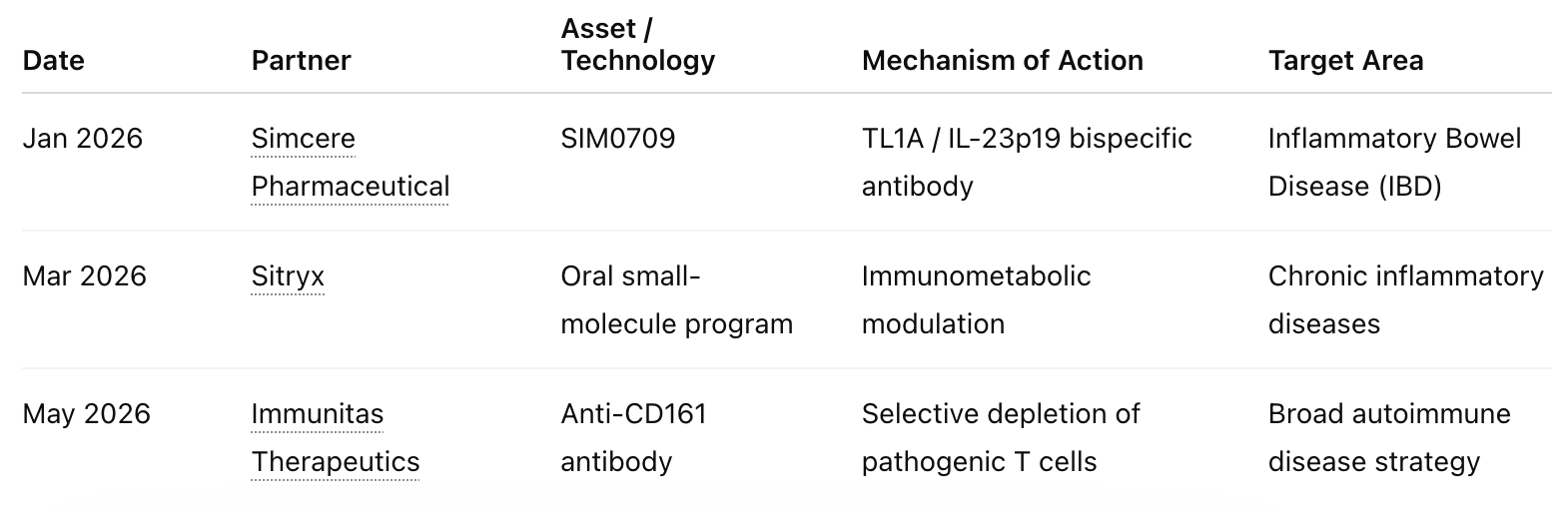
BI is pivoting from a single-pathway focus to a "full-stack" layout. While SIM0709 covers classic cytokine pathways and Sitryx explores metabolic reprogramming, the Immunitas deal allows BI to enter the cell-depletion therapy arena, completing a vital piece of the "Immune Resetting" puzzle. Compared to the currently crowded B-cell depletion space (e.g., CD19/CD20), T-cell targeting offers broader differentiation potential in fibrosis and specific T-cell-driven inflammatory diseases.
Risks and Challenges: A Difficult Road Ahead
Despite the compelling scientific narrative, the project faces significant hurdles from an R&D perspective:
-
Safety Window: Will the large-scale depletion of T-cell subsets lead to serious immunodeficiency or risks of opportunistic infections?
-
The Abcuro Lesson: Previously, the anti-KLRG1 drug ulviprubart, which also aimed to deplete pathogenic T cells, faced setbacks in late-stage clinical trials. This serves as a reminder that the actual performance of "selective depletion" in humans—such as the activation of compensatory immune pathways—is far more complex than in models.
-
Biomarkers: Precisely defining and screening the patient populations most likely to benefit from "CD161+ cell depletion" will be the "make-or-break" factor for Phase 1b/2 Proof-of-Concept (PoC).
Summary
The collaboration between Boehringer Ingelheim and Immunitas marks a profound shift in how Big Pharma approaches the underlying logic of autoimmune therapy. Moving from "signal blockade" to "cell clearance" is not just a technical upgrade; it is a new attempt to achieve a "cure-like" remission in autoimmune diseases.
For R&D professionals, human clinical data regarding the CD161 target will be one of the most critical variables to watch in the autoimmune field over the next decade.
