

 5 min
5 minIn the treatment of hypertrophic cardiomyopathy (HCM), a primary challenge in drug development has been improving impaired cardiac relaxation without compromising systolic function—specifically, avoiding reductions in Left Ventricular Ejection Fraction (LVEF).
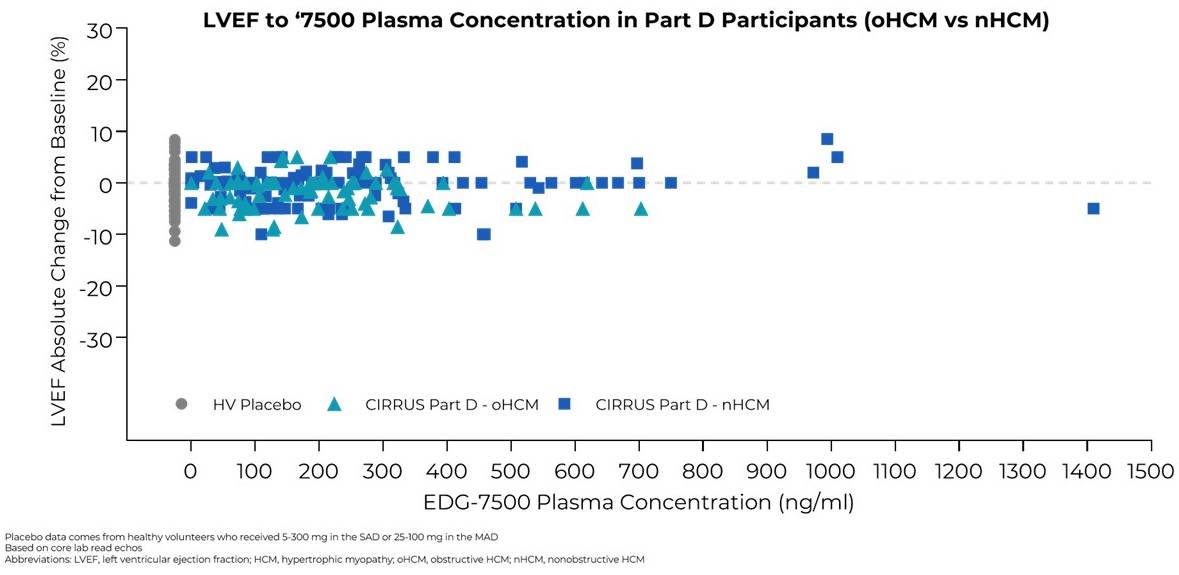
On June 16, 2026, Edgewise Therapeutics announced positive top-line results from its Phase 2 CIRRUS-HCM study. The data demonstrate that EDG-7500, a next-generation cardiac sarcomere modulator, exhibits clinical efficacy in both obstructive (oHCM) and nonobstructive (nHCM) patients. Notably, across more than 700 echocardiogram assessments, there was no observed correlation between drug exposure and LVEF decline, and no patient experienced an LVEF reduction below 50%. For HCM patients who have long faced limited treatment options, these results suggest the emergence of a new therapeutic approach that balances efficacy with a favorable safety profile.
Breakthrough Clinical Performance: Maintaining Systolic Integrity
EDG-7500 is an innovative, highly selective cardiac sarcomere modulator designed to slow early contraction velocity and improve impaired cardiac relaxation. The results reported today cover 53 patients across both oHCM and nHCM cohorts who completed 12 weeks of treatment.
The safety profile is particularly significant: throughout the study, no negative relationship was observed between EDG-7500 exposure and LVEF, and no LVEF fell below 50%. This indicates that EDG-7500 can improve cardiac function while successfully avoiding the systolic functional impairment often associated with traditional cardiac myosin inhibitors (CMIs).
Clinical Data: Benefits Across oHCM and nHCM
1. Significant Improvement in Obstructive HCM (oHCM)
In the oHCM cohort, EDG-7500 demonstrated broad improvements in hemodynamics and patient-reported outcomes:
-
Hemodynamic Optimization: 90% of patients showed improvement in left ventricular outflow tract gradient (LVOT-G).
-
Biomarker Benefits: 74% of patients achieved normalization of NT-proBNP (a key marker of heart failure) or a ≥50% reduction from baseline.
-
Functional and Health Status: Patients reported a mean increase of 24 points on the Kansas City Cardiomyopathy Questionnaire (KCCQ-OSS), and 70% of patients exhibited at least a one-class improvement in New York Heart Association (NYHA) functional classification.
-
Enhanced Diastolic Function: The e' lateral (early diastolic mitral annular velocity), a key indicator of relaxation, improved by a mean of approximately 20%.
2. Robust Support for Nonobstructive HCM (nHCM)
nHCM patients have long lacked effective treatment options; EDG-7500 demonstrated robust efficacy in this group as well:
-
Heart Failure Biomarkers: Approximately 88% of patients achieved NT-proBNP normalization or a ≥50% reduction from baseline (with a mean reduction of approximately 65%).
-
Symptom and Functional Improvement: KCCQ-OSS scores increased by a mean of 13 points, and 64% of patients improved by at least one NYHA functional class.
-
Improved Relaxation: The mean e' lateral increased by 37%. Furthermore, a high-frame-rate sub-study showed a 6.1-point improvement in the E/e' ratio, signaling a substantial improvement in diastolic function.
Expert Perspectives: Differentiated Clinical Value
Dr. Kevin Koch, President and CEO of Edgewise Therapeutics, stated that the goal in developing EDG-7500 was to avoid the "liability" of systolic impairment inherent in the CMI class. Current data suggest that EDG-7500 has achieved this goal, with a profile that avoids compromising LVEF, providing unique potential in treating a broad spectrum of HCM, including nHCM.
Dr. Matthew Martinez, President of the HCM Society, noted that these data are particularly encouraging because they improve diastolic relaxation without evidence of systolic risk. This offers a meaningful new approach for nHCM patients, addressing a significant unmet need and challenging the limitations of current care.
Next Steps: Advancing to Phase 3
Based on the favorable tolerability—with no new safety signals identified and AEs primarily mild to moderate—and the strong efficacy signals observed in the CIRRUS-HCM study, Edgewise Therapeutics has outlined its strategic next steps. The company plans to formally initiate Phase 3 clinical development of EDG-7500 in the fourth quarter of 2026.
As clinical evidence continues to accumulate, EDG-7500 is evolving from an early-stage mechanical regulator to a front-line candidate for the treatment of heart failure and cardiomyopathy. For millions of HCM patients worldwide, this innovative therapy aimed at treating "cardiac stiffness" and diastolic dysfunction may well prove to be the key to rewriting the standard of care for HCM.
