

 5 min
5 minConcurrent with its fiscal year 2026 earnings release, Immunovant announced preliminary clinical data for its lead pipeline asset, IMVT-1402, in patients with difficult-to-treat rheumatoid arthritis (D2T RA). These results not only validate the therapeutic potential of the agent in patients who have failed multiple lines of therapy but also mark a significant milestone in the company’s strategic pivot to prioritize this program.
Breakthrough in the D2T RA Landscape
The reported data stem from the Phase II trial (Period 1, open-label) of IMVT-1402 in D2T RA. The study enrolled patients who had failed at least two prior advanced therapeutic mechanisms (including biologics and targeted synthetic DMARDs). The cohort presented with a mean disease duration of 12.8 years and high baseline disease activity (mean DAS28-CRP score of 6.1).
Following 16 weeks of weekly 600 mg subcutaneous (SC) dosing, IMVT-1402 demonstrated significant clinical benefit:
-
ACR Response Rates: Among 165 evaluable patients, ACR20, ACR50, and ACR70 response rates were 72.7%, 54.5%, and 35.8%, respectively.
-
Refractory Subgroup Performance: In a subset of patients who had failed at least one JAK inhibitor and one anti-TNF inhibitor (N=107), efficacy remained consistent, with ACR20, ACR50, and ACR70 response rates of 72.0%, 53.3%, and 37.4%, respectively.
Given the high bar for enrollment, an ACR20 response rate exceeding 70% highlights the potential of the FcRn-targeting mechanism in clearing pathogenic autoantibodies, such as rheumatoid factor (RF) and anti-citrullinated protein antibodies (ACPA). To minimize potential assessor bias inherent in open-label designs, the study utilized independent blinded assessors to evaluate joint counts.
Strategic Pivot: All-in on IMVT-1402
Following the failure of the batoclimab Phase III trial in thyroid eye disease (TED) to meet its primary endpoint, Immunovant discontinued the batoclimab program to concentrate all resources on IMVT-1402.
Development of IMVT-1402 remains on track across several key indications:
-
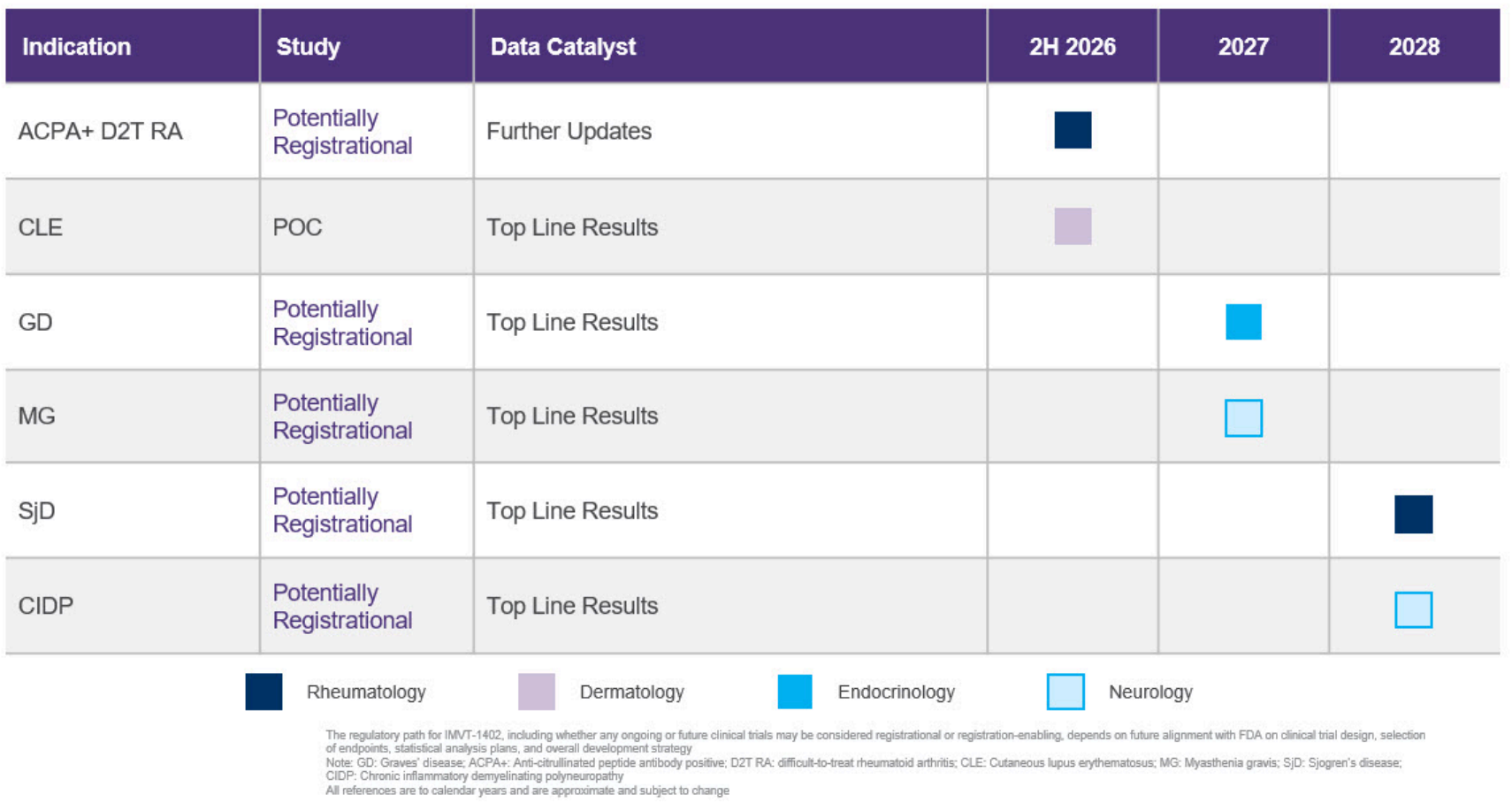
Registrational Programs: Ongoing trials in Graves’ disease (GD), myasthenia gravis (MG), chronic inflammatory demyelinating polyneuropathy (CIDP), and Sjögren’s disease (SjD).
-
Upcoming Milestones: Further updates on the D2T RA program and topline data from the cutaneous lupus erythematosus (CLE) proof-of-concept trial are expected in the second half of 2026.
-
Data Outlook: Topline data from potential registrational trials in GD and MG are anticipated in 2027.
Financial Standing and Clinical Outlook
As of March 31, 2026, Immunovant reported approximately $902.1 million in cash and cash equivalents. The company expects this runway to be sufficient to support the development of all announced indications through the potential commercial launch of IMVT-1402 in Graves' disease. The increase in R&D expenses primarily reflects the expansion of clinical trial activities and the contractual costs associated with the discontinuation of the batoclimab program.
Perspective on the Future of FcRn Inhibitors
Targeting FcRn to accelerate the clearance of IgG—including pathogenic autoantibodies—provides a distinct biological approach compared to traditional DMARDs. For R&D professionals, two areas remain critical to monitor:
-
Period 2 Randomized Data: While the ACR responses from the open-label phase are promising, the definitive "litmus test" will be the randomized, placebo-controlled data from Period 2. This will provide insights into durability of effect and relapse mechanisms after treatment withdrawal or dose reduction.
-
Long-term Safety: As clinical exposure increases, monitoring for adverse events associated with sustained IgG depletion and potential hypoalbuminemia will remain a primary focus of the clinical development program.
While the preliminary signals from IMVT-1402 in D2T RA are encouraging, Immunovant's future success will depend on its ability to optimize dosing regimens and establish a differentiated safety profile within the increasingly competitive global immunology landscape.
