

 5 min
5 minOn July 21, 2026, IMUNON today announced updated positive preliminary data from its ongoing Phase II minimal residual disease (MRD) conversion clinical trial of IMNN-001. The trial combines IMNN-001 with standard neoadjuvant and adjuvant chemotherapy (N/ACT) plus bevacizumab in women with newly diagnosed advanced ovarian cancer.
IMUNON’s IL-12 targeted immunotherapy, IMNN-001, built on its non-viral DNA plasmid platform, has demonstrated significant minimal residual disease (MRD) clearance capability in a Phase II translational trial for first-line treatment of advanced ovarian cancer. It has also successfully validated the mechanistic feasibility of overcoming the systemic toxicities historically associated with conventional IL-12 therapies through localized expression.
Background and Mechanism of Action
Epithelial ovarian cancer is characterized by insidious onset and high mortality, with approximately 70% of patients already diagnosed at locally advanced stages (Stage III/IV). A typical pathological feature is widespread intraperitoneal tumor dissemination. Despite receiving standard neoadjuvant/adjuvant chemotherapy (N/ACT) and cytoreductive surgery, recurrence rates remain as high as 75% in advanced-stage patients. Since the disease is largely confined to the peritoneal cavity, this provides an ideal window for local immunomodulatory interventions.
IMNN-001 is a non-viral DNA-mediated immunotherapy developed using IMUNON’s proprietary TheraPlas® platform. The drug utilizes a nanoparticle delivery system to encapsulate a DNA plasmid vector encoding interleukin-12 (IL-12). Following intraperitoneal administration, the drug transfects local cells, inducing sustained secretion of IL-12 protein within the peritoneal cavity. IL-12 is a potent pro-inflammatory cytokine that promotes the proliferation and activation of T lymphocytes and natural killer (NK) cells. However, the clinical development of recombinant IL-12 protein has been stalled for decades due to its propensity to trigger fatal cytokine release syndrome (CRS) and other systemic toxicities. The development strategy for IMNN-001 aims to activate local anti-tumor immunity while blocking systemic exposure through localized, sustained gene expression.
Clinical Efficacy
The preliminary data released come from a Phase II MRD translational clinical trial evaluating IMNN-001 in combination with standard neoadjuvant/adjuvant chemotherapy and bevacizumab. Led by the MD Anderson Cancer Center, the study’s core objective is to assess the impact of immuno-chemotherapy on the tumor microenvironment and MRD following first-line treatment.
The study plans to enroll 30 patients. Currently, 9 patients in the experimental group and 9 in the control group have reached the second-look laparoscopy (SLL) time point. SLL is a direct and stringent endpoint for assessing surgical MRD status. The data show clear efficacy signals:
-
MRD Positivity Rate:
The experimental group (IMNN-001 combination) had an MRD positivity rate of 44%, compared to 67% in the control group. -
ctDNA Clearance Rate:
The experimental group achieved an 87.5% circulating tumor DNA (ctDNA) clearance rate, versus 62.5% in the control group. -
No Evidence of Disease (NED) Rate:
Following first-line treatment, 100% of patients in the experimental group achieved NED status, compared to 56% in the control group.
These data further corroborate the survival benefits observed in the previously completed Phase II OVATION 2 study. In OVATION 2, IMNN-001 extended median overall survival (OS) by 14.7 months compared to chemotherapy alone (45.1 months vs. 30.4 months); in the subgroup also receiving PARP inhibitor maintenance therapy, the OS benefit expanded to 24.2 months (65.6 months vs. 41.4 months).
Milestone Significance
The core medical significance of this study lies in demonstrating the potential of a non-viral plasmid delivery system to address the druggability challenges of highly toxic cytokines. Translational medicine analyses revealed that IMNN-001 induced robust IL-12 expression in macrophages within peritoneal fluid and tumor tissues, subsequently stimulating an anti-tumor cytokine cascade, including interferon-gamma. This process effectively activated macrophages and T cells, converting the ovarian cancer tumor immune microenvironment from "cold" to "hot."
Regarding safety, even when combined with bevacizumab and standard chemotherapy, IMNN-001 maintained a favorable tolerability profile. No cytokine release syndrome (CRS), systemic toxicity, or severe immune-related adverse events were observed in the trial. These safety data clinically confirm that nanoparticle-based local DNA delivery technology can successfully bridge the historical safety gap associated with IL-12-class agents, providing a validated technological pathway for regional immunomodulation with cytokines.
Comparative Landscape of Other IL-12 Pipeline Candidates
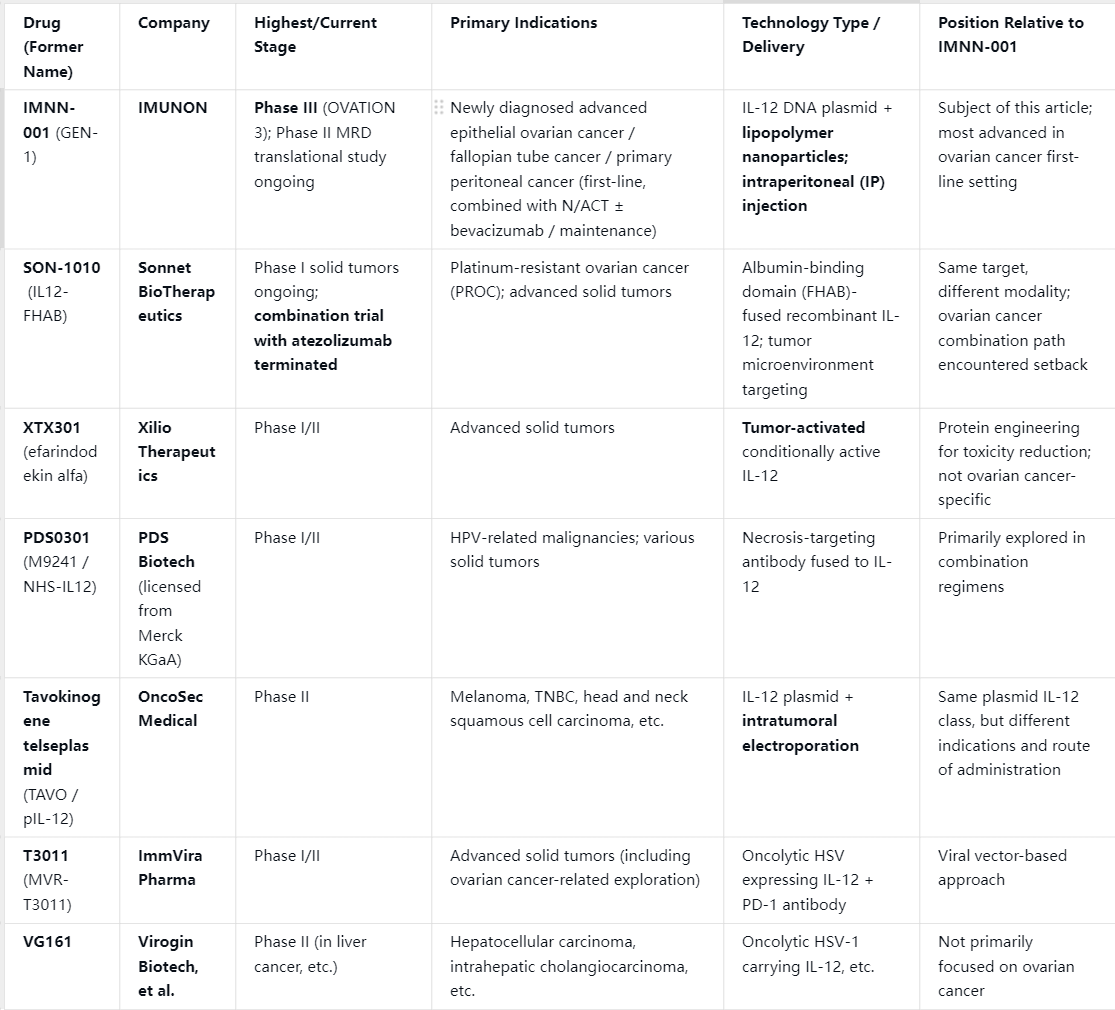
IL-12, as a potent anti-tumor cytokine, has historically faced development hurdles due to systemic toxicity. The current industry consensus is high exposure in the tumor/local microenvironment with low systemic exposure. By technological approach, the main active pipeline candidates are as follows (public information, non-exhaustive).
Key Clinical-Stage Drug Candidates
Company's Next Steps
Regarding clinical advancement, IMUNON will continue progressing its current Phase II MRD study until completion of enrollment for all 30 patients. The company plans further collection and tracking of long-term data for the secondary endpoint—progression-free survival (PFS). Concurrently, the pivotal Phase III clinical trial (OVATION 3) in treatment-naïve advanced ovarian cancer is actively recruiting patients across clinical sites nationwide in the United States, with the aim of building a more comprehensive benefit-risk data profile.
In terms of pipeline planning, the company will continue to advance its non-viral DNA technology development, leveraging the TheraPlas® platform (for cytokine delivery in solid tumors) and the PlaCCine® platform (for viral antigen delivery). In addition to advancing its core pipeline independently, IMUNON plans to explore the potential application of its plasmid DNA technology in other difficult-to-treat diseases through external partnerships.
