

 5 min
5 min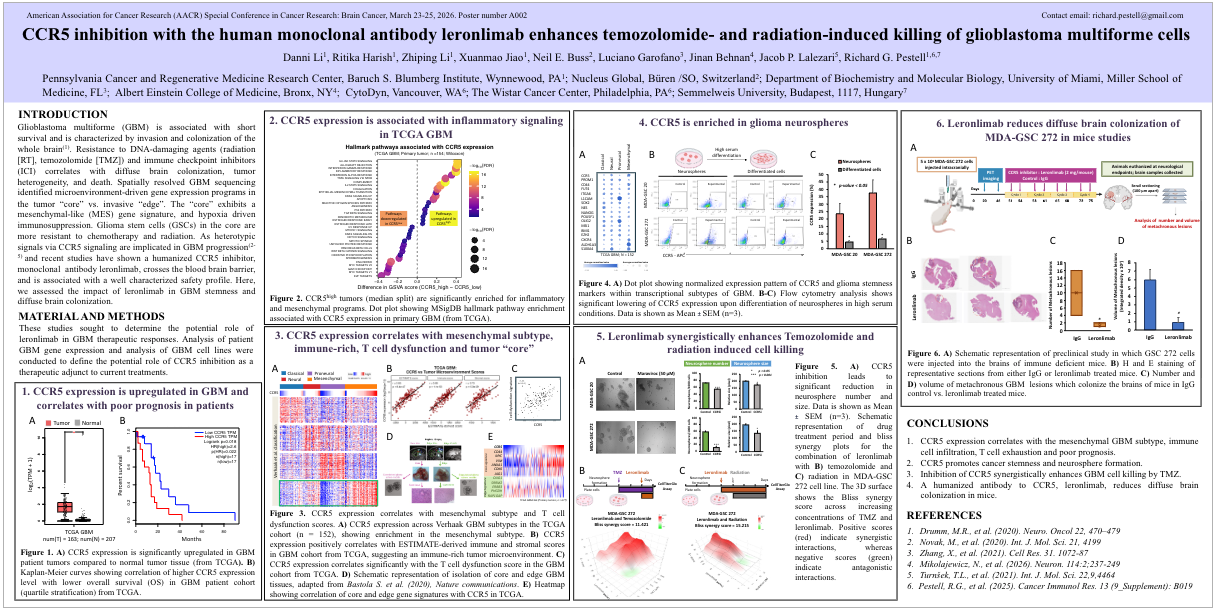
1. Core Insight: CCR5 as a "Fatal Flaw" in GBM
Glioblastoma Multiforme (GBM) remains one of the most challenging cancers due to its high invasiveness and resistance to standard care. Research identifies the CCR5 receptor as a significant driver of malignancy and a robust negative prognostic indicator.
-
Survival Impact: Patients with high CCR5 expression face a significantly shorter median survival of approximately 13–15 months, compared to 22–25 months for the low-expression group.
-
Increased Mortality: High CCR5 levels correlate with a 2.6-fold increased risk of death (Hazard Ratio = 2.6, p=0.022).
-
Subtype Enrichment: CCR5 expression is specifically enriched in the Mesenchymal subtype, which is clinically recognized as the most aggressive and treatment-resistant form of GBM.
2. Mechanism: Why Target CCR5?
CCR5 is not merely a marker; it is intricately linked to the biological programs that drive tumor recurrence and immune evasion.
-
Cancer Stemness: CCR5 is highly enriched in glioma neurospheres (GSCs), which are responsible for therapy resistance and tumor regrowth.
-
Immune Suppression: High CCR5 levels correlate strongly with T cell dysfunction (exhaustion) signatures (R=0.55, p=3.2 \times 10^{-12}), suggesting an immunosuppressive microenvironment.
-
Inflammatory Signaling: CCR5 expression is associated with key pro-tumorigenic pathways, including IL6/JAK/STAT3 and TNFA signaling via NFKB.
3. Therapeutic Breakthrough: The Impact of Leronlimab
Leronlimab is a humanized monoclonal antibody that crosses the blood-brain barrier and effectively inhibits CCR5 signaling.
A. Synergistic Killing: Doubling Down on Standard Care
Using Bliss synergy modeling (where a score >10 indicates significant synergy), Leronlimab was shown to sensitize GBM cells to conventional treatments:
-
Leronlimab + Temozolomide (TMZ): Achieved a synergy score of 11.421.
-
Leronlimab + Radiation: Achieved a synergy score of 15.215.
B. Halting Invasion: Reducing Brain Colonization
In preclinical mouse models, Leronlimab demonstrated a dramatic ability to stop the "seeding" of secondary tumors:
-
Lesion Count: The number of metachronous lesions (secondary sites) dropped from a median of 10 in the control group to just 1–2 lesions in the treatment group.
-
Tumor Volume: The total volume of colonizing lesions was reduced by approximately 83% (from an integrated density of 6.0 \times 10^7 to 1.0 \times 10^7).
4. Conclusion & Clinical Outlook
-
Targeted Precision: Leronlimab targets the resilient stem-like cell niche often left behind by surgery and radiation.
-
Safety Profile: The drug has a well-characterized safety profile, supporting its potential as a therapeutic adjunct to standard GBM protocols.
-
Inhibiting Metastasis: By blocking the CCR5 axis, Leronlimab addresses one of the most lethal aspects of GBM—its highly invasive and diffuse nature.
