

 5 min
5 minRegeneron announced topline results from its Phase III clinical trial evaluating the LAG-3 inhibitor fianlimab in combination with the PD-1 inhibitor cemiplimab for the first-line treatment of unresectable locally advanced or metastatic melanoma.
Data revealed that the trial missed its primary endpoint of improving progression-free survival (PFS). Although the difference did not achieve statistical significance, a notable numerical improvement of 5.1 months in median PFS was observed in the high-dose combination arm.
Core Clinical Data Breakdown
This randomized, double-blind Phase III trial enrolled ,1546 treatment-naïve patients with advanced melanoma (aged $\ge$ 12). The study was designed to evaluate the efficacy of different doses of fianlimab combined with cemiplimab (high-dose vs. low-dose) compared to pembrolizumab (Keytruda) monotherapy and cemiplimab monotherapy.
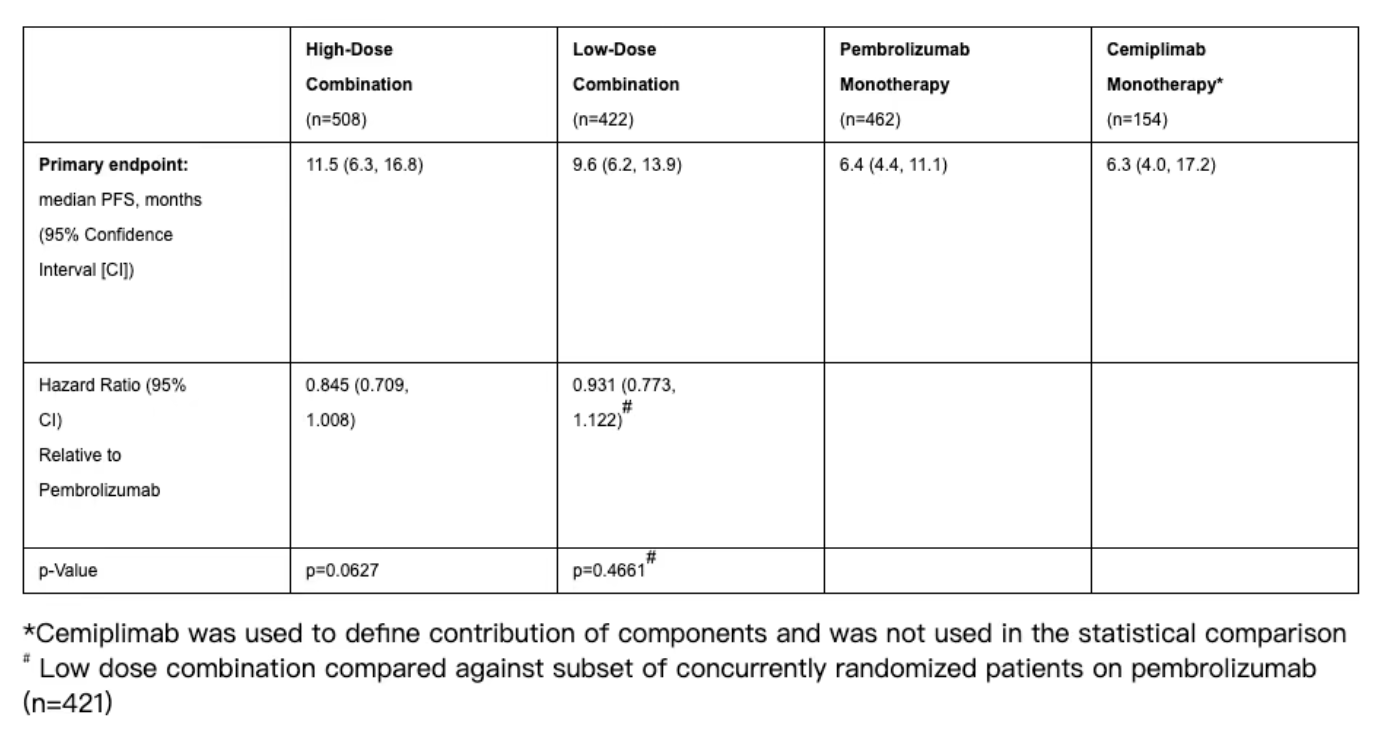
The median PFS outcomes across the treatment arms were as follows:
-
High-Dose Combination Arm (n=508): Median PFS reached 11.5 months; Hazard Ratio (HR) = 0.845 vs. pembrolizumab monotherapy (p = 0.0627).
-
Low-Dose Combination Arm (n=422): Median PFS was 9.6 months; HR = 0.931 vs. pembrolizumab monotherapy (p = 0.4661).
-
Pembrolizumab Monotherapy Arm (n=462): Median PFS was 6.4 months.
-
Cemiplimab Monotherapy Arm (n=154): Median PFS was 6.3 months (utilized as an internal control and not factored into primary statistical comparisons).
From an efficacy standpoint, the high-dose fianlimab combination prolonged median PFS from 6.4 months to 11.5 months, yielding a substantial numerical extension of 5.1 months. However, because the p-value (0.0627) slightly exceeded the conventional 0.05 threshold, this extension failed to achieve success in a strict statistical sense.
Safety Profile
On the safety front, the fianlimab combination therapy demonstrated a stable and consistent profile. No new safety signals were identified during the trial, providing foundational support for the continued development of this pipeline. Regeneron stated that detailed data from the trial will be presented at an upcoming medical meeting.
Subsequent R&D Strategy
Despite missing a definitive win against pembrolizumab in this study, Regeneron is actively maintaining its momentum in the LAG-3 landscape. Currently, an ongoing Phase III trial is executing a direct head-to-head comparison between the high-dose fianlimab combination therapy and Bristol Myers Squibb’s (BMS) Opdualag® (a fixed-dose combination of nivolumab and relatlimab) in the first-line unresectable or metastatic melanoma setting.
Industry Perspective
LAG-3 has long been regarded as the most promising immune checkpoint target following PD-1 and CTLA-4, yet its clinical development path remains fraught with challenges. Regeneron's setback in meeting the primary endpoint underscores the immense difficulty of demonstrating superiority for novel immuno-oncology (IO) combinations in the first-line treatment of melanoma.
Nevertheless, given its clean safety profile and encouraging numerical PFS benefits, the therapeutic potential of fianlimab is far from written off. The industry will closely watch its upcoming head-to-head showdown with the first-in-class product, Opdualag, which will likely serve as the decisive battle determining the drug's ultimate clinical and market destiny.
