

 5 min
5 minREGENXBIO announced positive topline results from the pivotal Phase III portion of its AFFINITY DUCHENNE® trial evaluating RGX-202, an investigational AAV gene therapy for Duchenne muscular dystrophy (DMD).
In the DMD gene therapy landscape, establishing a definitive, causative link between microdystrophin expression levels and true clinical functional benefits has long been a focal point of regulatory scrutiny. The newly released dataset for RGX-202 explicitly demonstrates this correlation with high statistical significance for the first time, laying a robust foundation for a anticipated accelerated approval pathway in 2027.
Differentiated Construct: The Structural Biology Significance of the C-Terminal Domain
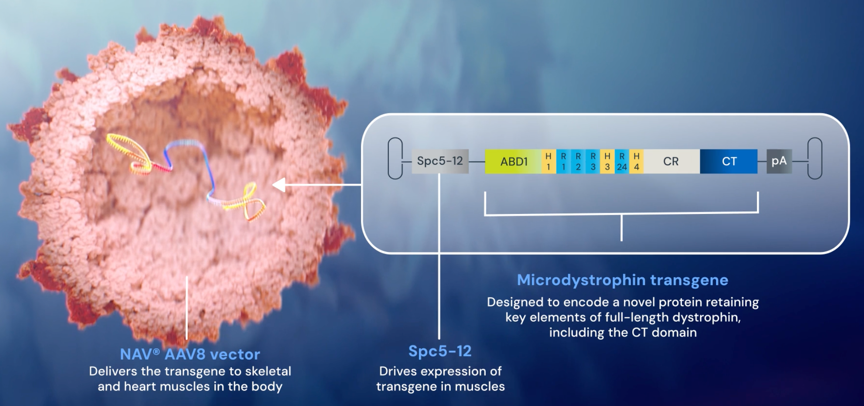
Compared to currently approved or in-development counterparts, the core competitive edge of RGX-202 lies in its novel vector construct design.
-
Structural Integrity: The microdystrophin expressed by RGX-202 uniquely includes the C-Terminal domain.
-
Precise Localization: Clinical data confirms that RGX-202 successfully anchors to the sarcolemma. In its natural physiological state, the C-terminal domain mediates the binding of microdystrophin to the sarcolemma-associated protein complex, playing a pivotal role in preserving the mechanical stability and durability of muscle fibers under stress.
-
High-Purity Manufacturing: REGENXBIO utilizes a proprietary suspension-based manufacturing process to achieve an industry-leading full capsid ratio (>80%), significantly mitigating the immunogenicity risks typically driven by empty capsids.
Clinical Data Interpretation: Bridging Biomarkers and Functional Gains
The disclosed topline data encompasses 31 ambulatory patients aged 1 and older, treated at a dose of 2×10¹⁴GC/kg.
1. Robust Protein Expression (Primary Endpoint)
-
Responder Rate: 93% of participants achieved microdystrophin expression above 10% at Week 12 (n=30, p < 0.0001).
-
Expression Intensity: The mean microdystrophin expression level across all participants reached an impressive 71.1%. Even in the more challenging cohort of older boys (aged >8), the mean expression level remained highly robust at 41.6%.
2. Functional Improvement and Statistical Correlation (A Field Milestone)
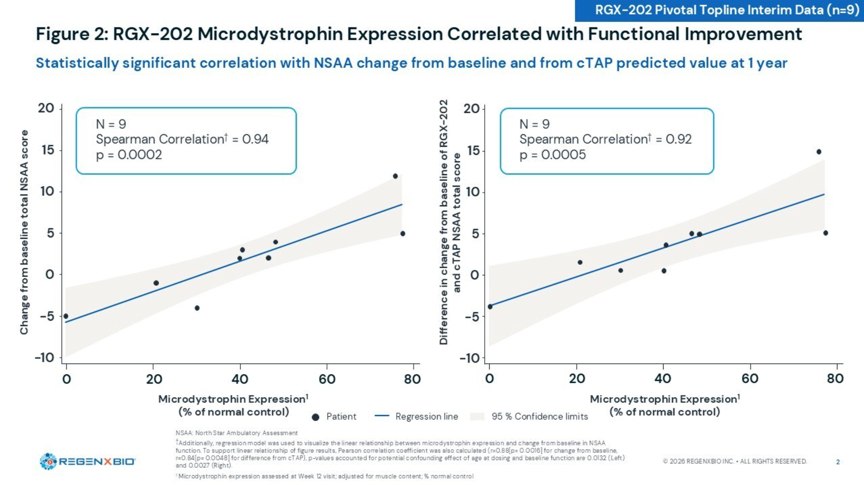
This is the defining highlight of the RGX-202 data: a statistically significant correlation was demonstrated between Week 12 microdystrophin expression and functional improvement at Year 1, measured by changes in the North Star Ambulatory Assessment (NSAA) score (correlation = 0.094, p = 0.0002).
-
NSAA & Timed Function Performance: After one year of treatment, participants demonstrated significant improvements in NSAA scores and all timed function tests (such as time to stand, 10-meter walk/run, and time to climb stairs) compared to a propensity score-weighted external control group.
-
Trajectory Modification: The data indicates that RGX-202 effectively altered the expected progressive physiological decline trajectory in older patients, underscoring its potential as a best-in-class gene therapy.
Safety Profile: Validation of a Proactive Immunosuppression Strategy
The safety window of AAV gene therapies remains a critical focus of clinical development. RGX-202 demonstrated a controlled and highly favorable safety profile:
-
Immunomodulatory Regimen: A proactive, short-term immunosuppression regimen successfully mitigated acute inflammatory responses typically triggered by high-dose AAV vectors.
-
Serious Adverse Events (SAEs): Two SAEs were reported (one case of subacute myocarditis and one case of asymptomatic liver injury). Both were easily manageable and resolved within weeks without long-term sequelae. Notably, no myocardial fibrosis or changes in ejection fraction were observed in the myocarditis case.
-
Hepatotoxicity Monitoring: Crucial liver inflammation biomarkers, such as mean gamma-glutamyl transferase (GGT) and total bilirubin, remained entirely below the upper limit of normal (ULN) within one year post-treatment (n=9).
Regulatory Pathway: Feasibility Analysis of Accelerated Approval
Recent communications between REGENXBIO and the FDA yielded highly encouraging signals for the gene therapy sector:
-
Surrogate Endpoint Validation: The FDA noted that utilizing microdystrophin expression as a surrogate endpoint for accelerated approval must be anchored in correlation analyses with clinical outcomes. The current dataset for RGX-202 explicitly fills this evidentiary gap.
-
Acceptance of External Controls: While the FDA generally prefers randomized controlled trials, the agency guided that external control trials may suffice to provide substantial evidence of effectiveness in rare diseases, particularly when the treatment effect size is robust enough to overcome the inherent limitations of external cohorts.
-
Timeline: REGENXBIO plans to pursue an accelerated approval pathway, targeting a potential commercial launch in 2027.
A New Benchmark in DMD Gene Therapy
The success of RGX-202 extends beyond a corporate victory for REGENXBIO; it represents a major triumph for AAV gene therapy in the complex landscape of neuromuscular disorders. By engineering a construct that more closely mimics naturally occurring dystrophin (via the inclusion of the C-terminal domain) and pairing it with a highly purified manufacturing process, RGX-202 sets a new standard: microdystrophin must not only "express," but it must "localize correctly" and "mechanistically correlate with functional recovery."
