

 5 min
5 minIndividualized neoantigen therapy development from melanoma adjuvant treatment needs
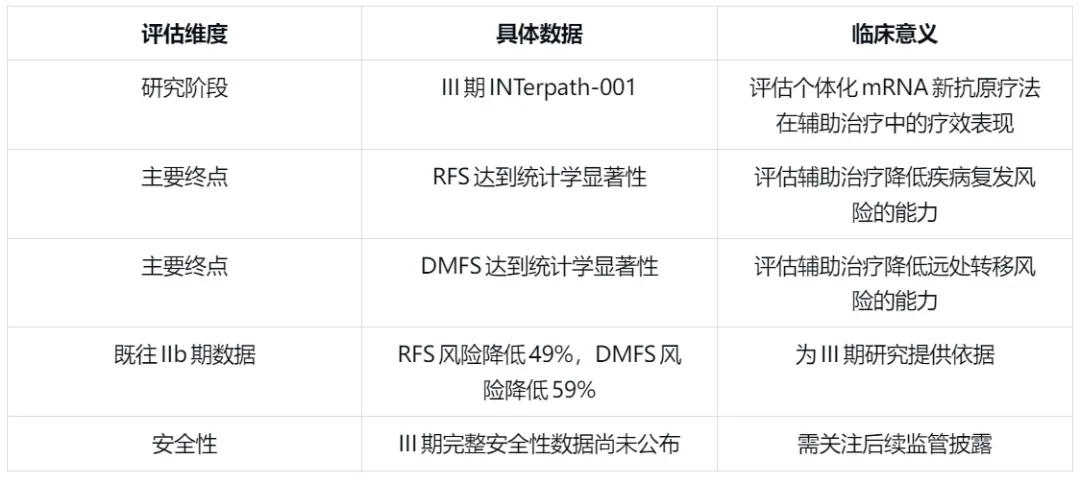
Moderna and Merck’s Intismeran Autogene, in association with Keytruda, met two major endpoints of RFS and DMFS in the Phase III INTERpath-001 study in patients with high-risk melanoma who received complete resection.
Melanoma is one of the early breakthroughs in immunotherapy, but for high-risk patients after the completion of radical resection, disease recurrence and distant metastasis are still the main problems in clinical management. Therefore, how to further reduce the probability of recurrence in the auxiliary treatment stage is one of the directions of current research and development.
Intismeran Autogene uses the chemical neoantigen mRNA technology route. Its core idea is based on the patient's tumor-specific mutation information, designed with multiple tumor-specific neoantigen coding mRNA sequences, and enhanced anti-tumor immune response by inducing T cells to identify the patient's own tumor-associated antigens.
Previously, Intismeran Autogene and Keytruda showed better recurrence-free survival performance than Keytruda monotherapy in the KEYNOTE-942/mRNA-4157-P201 study, providing a basis for further Phase III studies.
Clinical data
INTERpath-001 is a randomized, double-blind, placebo-controlled Phase III study that evaluated the effectiveness of Intismeran Autogene and Keytruda for adjuvant treatment after complete excision of melanoma.
According to the information released so far, although the study has reached two major endpoints, it has not disclosed the full risk ratio (HR), median follow-up time, detailed subgroup analysis and safety data. The company said it expects to disclose more information in medical meetings or regulatory communications.
Long-term follow-up data from the previous KEYNOTE-942 study showed a 49% reduction in the risk of recurrence or death compared to Keytruda monotherapy (HR = 0.510) and a 59% reduction in the risk of distant metastasis or death (HR = 0.411).
Competitive Landscape: New Antigen Vaccine Joint Immunocheck Inhibitor Enters Late Validation Phase
In recent years, tumor-individualized immunotherapy has focused on neoantigen vaccines, T-cell therapy, and immune checkpoint inhibitors combined strategies. Unlike traditional shared antigen vaccines, neoantigen therapy needs to be designed based on individual tumor mutations in patients, so the production process, patient individualization manufacturing and supply chain efficiency still needs to be solved in the process of industrialization.
Intismeran Autogene’s current development strategy is used in conjunction with Keytruda. Keytruda releases T-cell immunosuppression by blocking the PD-1 pathway, enhancing T-cell-mediated anti-tumor immune response, while Intismeran Autogene designs neoantigen mRNA sequences based on tumor-specific mutations in patients, further activating T-cell responses to tumor neoantigens. The two mechanisms are used to relieve immunosuppression and induce tumor-specific immune activation, forming a combination treatment foundation, which is also the main feature of the solution different from the simple immune checkpoint inhibition strategy.
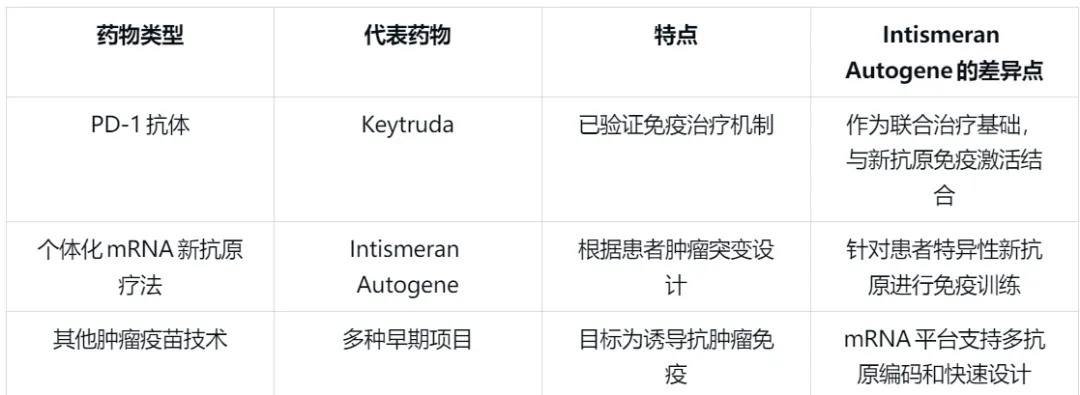
It is worth noting that individualized neoantigen therapy is still at different stages of development, and future competition depends not only on the degree of clinical benefit, but also by factors such as individualized production processes, manufacturing efficiency, and indications to expand. For Intismeran Autogene, the project is still in the regulatory advancement stage, and the full data disclosure in phase III, long-term follow-up results, and the maturity of the large-scale production system will further affect its subsequent registration path and commercial application.
The company's next step: to advance the regulatory work and expand the exploration of indications
In addition to melanoma, Moderna and Merck are also exploring the use of Intismeran Autogene in conjunction with Keytruda in other physical tumors. The two sides have previously conducted clinical studies in the field of oncology, covering multiple tumor types such as non-small cell lung cancer, bladder cancer and kidney cancer.
At present, the company's next focus is to continue to promote the supervision of INTERpath-001 and publish more detailed clinical data. At the same time, the two sides are also exploring the possibility of the application of this technology route in other physical tumors.

Overall, the primary endpoint of INTERpath-001 is an important node in the development of individualized neoantigen mRNA therapies. The follow-up still needs to pay attention to the complete phase III data, regulatory progress and large-scale production capacity. For the field of new drug research and development, it is more noteworthy whether the technical route can be further extended to more solid tumors, and the feasibility of individualized design patterns in large-scale clinical applications.
